Skip to content
Karnak Temple Complex — Complete Guide 2025 | EGYPEDIA
HomeArchaeological AreasLuxor · Theban Necropolis › Karnak Temple Complex
🏛️ East Bank, Luxor · UNESCO World Heritage · Largest Temple Ever Built

Karnak
Temple Complex

The largest religious site ever constructed — 247 acres of temples, pylons, obelisks, and sacred lakes built by 30+ pharaohs over 2,000 years. The spiritual heart of ancient Egypt for five centuries.
⭐ UNESCO 1979 247 Acres c. 2000 BC – 30 BC 30+ Pharaohs 134 Columns · Hypostyle Hall
247Acres Total Area
2,000Years of Construction
134Hypostyle Columns
600 EGPEntry Ticket (2025)
📍
East Bank, Luxor
Location
🎟️
600 EGP
Foreign Adult
🕐
6am – 5:30pm
Opening Hours
🌙
Sound & Light
Evening Show
📱
Allowed
Photography
⏱️
2–4 Hours
Recommended Time
🌡️
6am–9am
Best Visit Time
🚕
3 km
From Luxor Temple
𓊹
Site Identity
Karnak Temple Complex — Official Site Data
Ancient Egyptian Name
Ipet-Isut
"The Most Select of Places" — the holy of holies of Amun-Ra
Modern Arabic Name
الكرنك
Al-Karnak
Location
East Bank of the Nile
3 km north of Luxor Temple
GPS Coordinates
25.7188° N, 32.6573° E
Total Area
247 acres (100 hectares)
Larger than many ancient cities
Primary Deity
Amun-Ra — King of the Gods
Also Mut (wife) and Khonsu (son) — the Theban Triad
Construction Period
c. 2000 BC – 30 BC
Over 2,000 years · 30+ pharaohs
Number of Precincts
4 main precincts
Amun-Ra · Mut · Montu · Amenhotep IV
Number of Pylons
10 pylons
Each built by a different pharaoh
Number of Structures
200+ structures
Temples · Chapels · Obelisks · Colossi
UNESCO Status
World Heritage Site (1979)
As part of "Ancient Thebes with its Necropolis"
Sound & Light Show
Nightly in English, French, Arabic
Separate ticket · 1 hour
UNESCO World Heritage 1979 Largest Temple Ever Built Open to Visitors Daily Sound & Light Show Nightly
𓂀
History of Karnak

Karnak was not built — it grew. Over 2,000 years, every pharaoh who wanted to demonstrate power, piety, or legitimacy came here and added something. The result is the most complex religious monument in human history.

Ipet-Isut — The Most Select of Places

The ancient Egyptians called Karnak Ipet-Isut — "The Most Select of Places." It was the principal sanctuary of Amun-Ra, the king of the gods and the divine patron of the pharaohs. For nearly 2,000 years of the New Kingdom, when Egypt was the dominant superpower of the ancient world, Karnak was the spiritual and political centre of that power.

Construction began in the Middle Kingdom around 2000 BC with a modest sanctuary. But it was the New Kingdom pharaohs — beginning with Thutmose I (c. 1504 BC) — who transformed it into a colossus. Each successive pharaoh added a new pylon (the great gateway towers) in front of the existing one, extending the complex westward toward the Nile. The result is a sequence of 10 pylons, each representing a different reign, a different vision of grandeur.

The Wealth of Amun

By the reign of Ramesses III (c. 1184 BC), the Temple of Karnak owned 65 towns, 83 ships, 421,000 head of livestock, and 81,000 workers, according to the Harris Papyrus — the largest administrative document to survive from ancient Egypt. Amun's priesthood had become so wealthy and powerful that they effectively governed Upper Egypt as an independent religious state, a situation that eventually contributed to the collapse of the New Kingdom.

"No single building in the history of the world has been worked on for as long, by as many hands, in honour of a single idea — the divine kingship of Egypt — as the Temple of Karnak."
Karnak aerial
Karnak from above — the vast scale of the complex becomes clear: 247 acres of temples, courtyards, obelisks, and sacred lakes. The Precinct of Amun-Ra (centre-right) is the largest; the Sacred Lake is visible as a dark rectangle.
Construction Timeline
c.2000 BCMiddle Kingdom — first sanctuary to Amun established at Karnak
c.1504 BCThutmose I — builds Pylons 4 & 5, first obelisks, Hypostyle Hall beginnings
c.1473 BCHatshepsut — erects her towering obelisks, Red Chapel, beautifies the complex
c.1458 BCThutmose III — Festival Hall (Akh-Menou), removes Hatshepsut's images, builds Pylon 7
c.1290 BCSeti I — begins the Great Hypostyle Hall, the most spectacular addition
c.1279 BCRamesses II — completes and decorates the Great Hypostyle Hall
c.332 BCAlexander the Great — adds a small sanctuary in the central core
30 BCRoman conquest — construction ceases. Karnak used as a quarry for centuries.
𓃭
Inside the Complex

Karnak is not a single temple but a city of temples — 4 precincts, 10 pylons, 134-column hypostyle hall, sacred lakes, obelisks, and 200+ structures. Here is what to see and where.
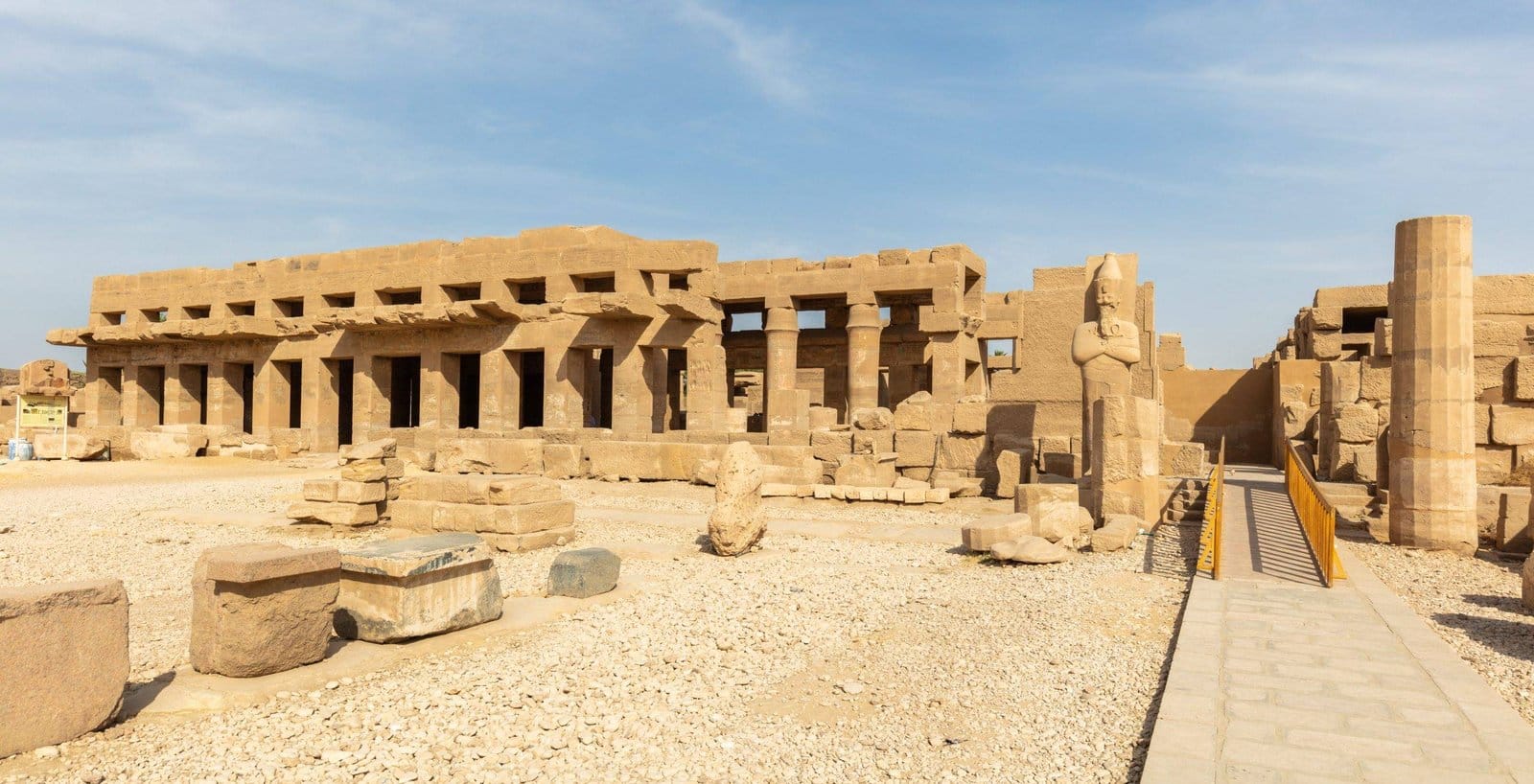
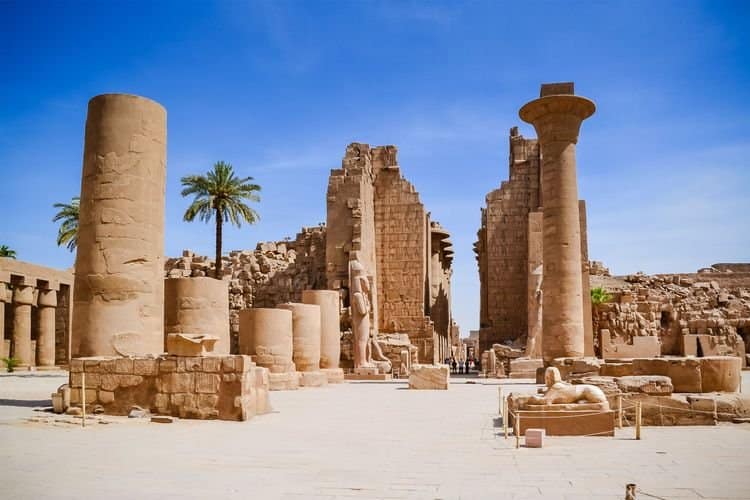
Hypostyle Hall
⭐ Most Important Structure
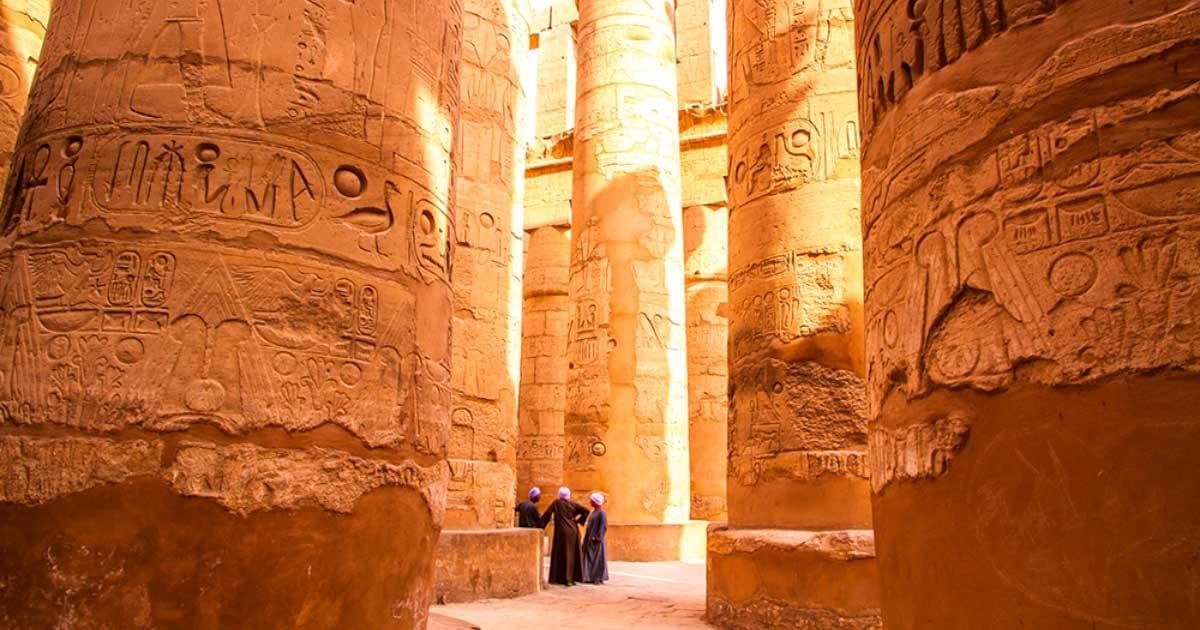
The Great Hypostyle Hall
The largest columned hall ever built — 5,000 m² supported by 134 columns in 16 rows. The 12 central columns stand 23 metres tall with papyrus-open-flower capitals. The outer 122 columns are 14 metres with closed-bud capitals. Every surface is carved with reliefs of Seti I and Ramesses II. The roof has fallen, but the play of light between the columns is unlike anything else in the ancient world.
5,000 m²134 columns23m central columnsSeti I + Ramesses II
Hatshepsut obelisk
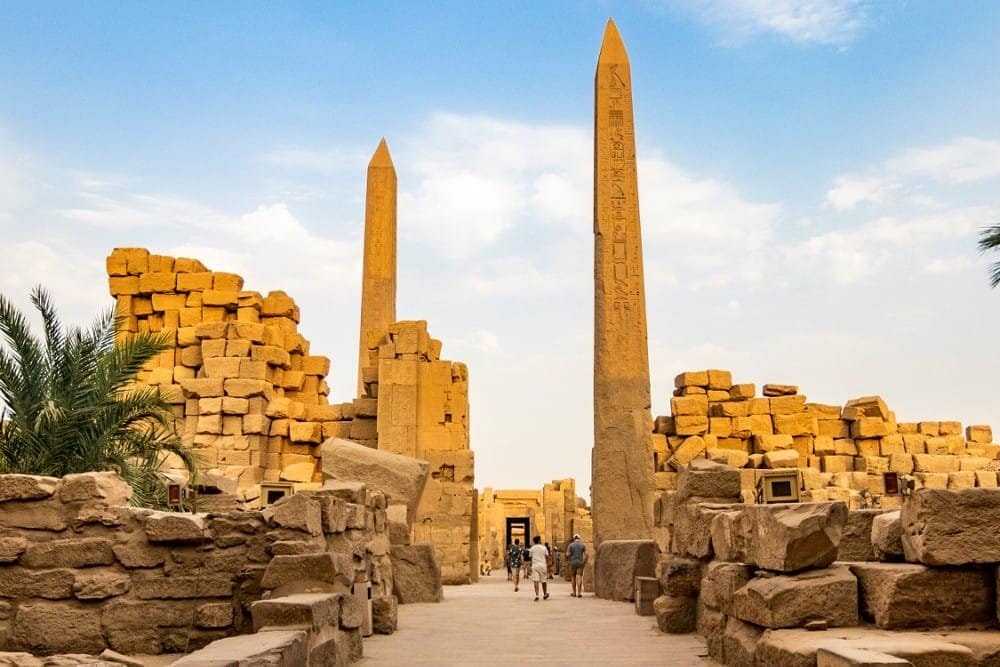
Obelisks of Hatshepsut
The Standing Obelisk of Hatshepsut
One of two obelisks erected by Queen Hatshepsut c. 1473 BC — 30 metres of red Aswan granite, still standing after 3,500 years. Originally sheathed in electrum (gold-silver alloy) at the top, which reflected the sunlight across Thebes. Her successor Thutmose III enclosed them in stone walls — which paradoxically preserved them. The hieroglyphic inscription praises Amun and records the obelisk's creation.
30 metres tallc.1473 BCAswan graniteHatshepsut
Sacred Lake
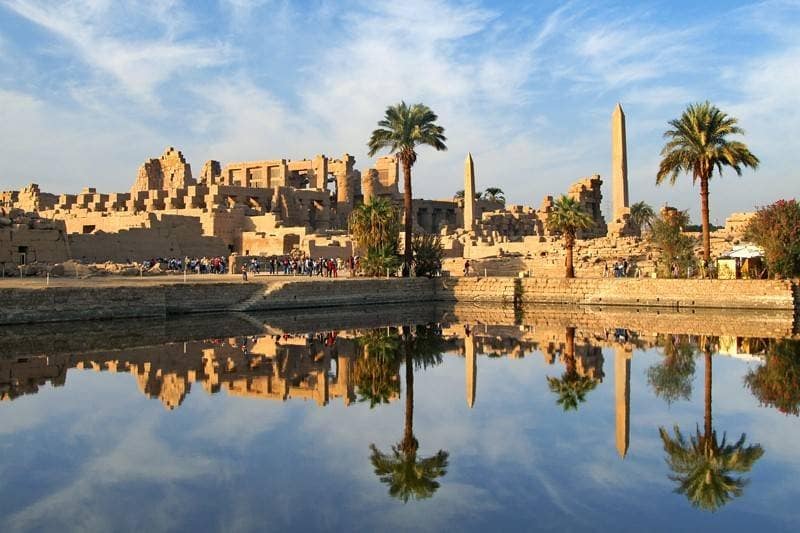
Sacred Lake — Isheru
The Sacred Lake
120 × 77 metres of still water — excavated by Thutmose III (c. 1458 BC) and fed by groundwater from the Nile. Used by priests for ritual purification before entering the temple. Sacred geese representing Amun were kept on its shores. Remarkably, the lake has never dried up in 3,000 years despite the extreme heat of Luxor. A giant stone scarab of Amenhotep III stands on the northwest corner — walking around it seven times is said to bring good luck.
120 × 77 metresNever dried upThutmose IIISacred scarab
Avenue of Sphinxes
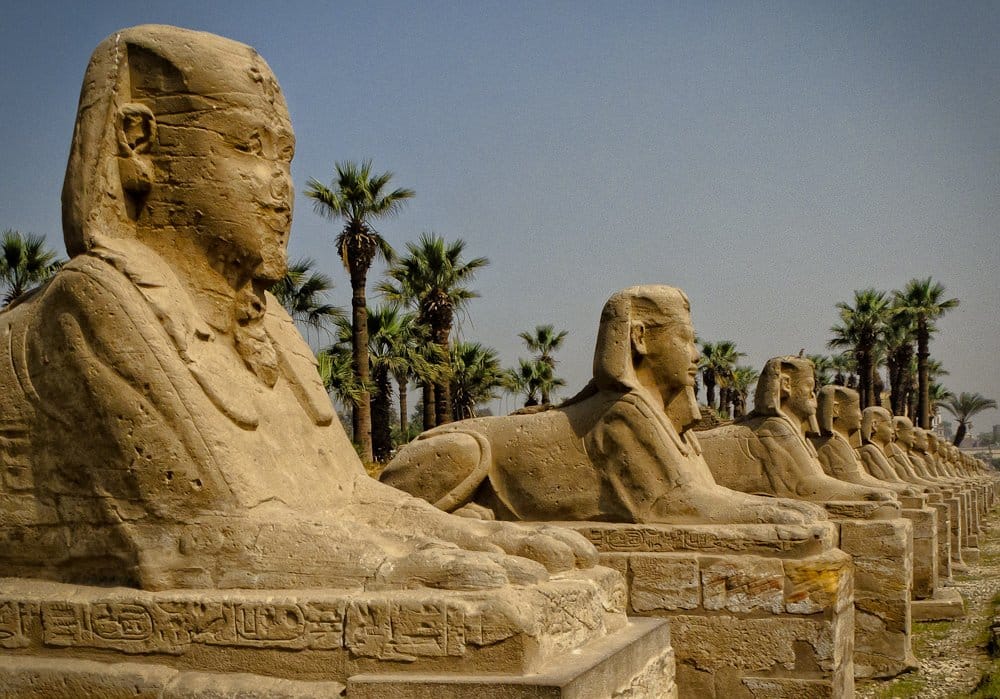
Avenue of Sphinxes
The Processional Avenue (Ram-headed Sphinxes)
The great approach to the First Pylon — lined with ram-headed sphinxes (criosphinxes), each with a small statue of Ramesses II between the paws. The ram is sacred to Amun. During the Opet Festival, the divine statue of Amun was carried in procession along this avenue from Karnak to Luxor Temple (3 km). The full avenue connecting both temples was restored and re-opened in 2021.
Ram-headed sphinxesRamesses IIOpet Festival routeRestored 2021
Festival Hall Thutmose III
Festival Temple of Thutmose III
Akh-Menou — The Festival Hall
Built by Thutmose III (c. 1458 BC) — one of Egypt's greatest military pharaohs. The "tent pole" columns are unique in Egyptian architecture, resembling the poles of a military tent — a reference to Thutmose III's campaigns. Contains the famous "Botanical Garden" room with reliefs of exotic plants and animals brought from his campaigns in Syria and Palestine. Also contains early Christian frescoes (the hall was later used as a church).
Unique tent-pole columnsBotanical Garden roomThutmose IIILater Christian church
Open-Air Museum Karnak
Open-Air Museum (Separate Ticket)
Karnak Open-Air Museum
A separate enclosure housing the reconstructed smaller chapels and structures — including the White Chapel of Senusret I (Middle Kingdom, c. 1960 BC — one of the finest examples of Middle Kingdom art), the Red Chapel of Hatshepsut, and the Alabaster Chapel of Amenhotep I. These were dismantled in antiquity and their blocks used in later construction — recovered and painstakingly reassembled by archaeologists.
White Chapel (Senusret I)Red Chapel (Hatshepsut)Separate ticketMiddle Kingdom gems

A pylon is a massive gateway tower — the most visible element of Egyptian temple architecture. Karnak has 10, each built by a different pharaoh. They are numbered from inside (oldest, Pylon 4) to outside (newest, Pylon 1). This reverse numbering reflects the westward expansion of the complex toward the Nile over 1,000 years.

1
30th Dynasty — Nectanebo I · c. 380 BC
The outermost and largest pylon — also the latest and never completed
The grandest approach — 113 metres wide and 15 metres thick. Despite being the largest, it was never finished — the mud-brick construction ramps were left in place on the west face, still visible today. The unfinished state tells us more about ancient construction methods than any completed pylon.
113m wide
~43m tall (planned)
2
Horemheb · c. 1323–1295 BC · 18th Dynasty
Built largely from blocks of dismantled Amarna-period structures
Horemheb — the general who ended the Amarna heresy — filled the interior of this pylon with thousands of carved blocks from Akhenaten's temples at Karnak, providing invaluable information about the Amarna Period that would otherwise be lost.
Great Forecourt entrance
3
Amenhotep III · c. 1390–1352 BC · 18th Dynasty
Gateway to the Hypostyle Hall forecourt
Also filled with reused blocks from earlier structures, providing valuable material for archaeologists reconstructing earlier phases of Karnak's development.
Faces the Hypostyle Hall
4–5
Thutmose I · c. 1504–1492 BC · 18th Dynasty ⭐ Most Important
The oldest pylons at Karnak — where the hypostyle hall begins
The first pharaoh to build monumentally at Karnak. Between Pylons 4 and 5 stood Hatshepsut's two great obelisks — Thutmose III later enclosed them in stone walls (which preserved them). The sanctuary between these pylons was the original holy of holies.
Oldest pylons
c. 1504 BC
6
Thutmose III · c. 1479–1425 BC
Gateway to the Festival Hall
One of the smaller pylons — marks the transition from the main Amun precinct to Thutmose III's Festival Hall (Akh-Menou).
Small · Decorative
7–10
Various 18th Dynasty pharaohs · c. 1500–1350 BC
The southern axis — connecting toward the Precinct of Mut
The south-facing pylons extend the complex toward the Precinct of Mut. Pylons 7 and 8 were built by Thutmose III and Hatshepsut respectively. Between Pylons 9 and 10 once stood colossal statues. This axis leads eventually to Luxor Temple via the Avenue of Sphinxes.
South axis
→ Mut · → Luxor
⚡ 90-Minute Visit
The Essential Karnak
Enter through Avenue of Sphinxes · First Pylon → straight ahead 1. First Pylon — stand back and appreciate the scale (never finished)
2. Great Court — the vast open court with Ramesses II statues
3. Great Hypostyle Hall — the unmissable — allow 30 minutes minimum
4. Hatshepsut's Obelisk — one of two, 30 metres of red granite
5. Sacred Lake — circle the scarab for luck
🎯 3-Hour Visit
The Full Experience
Everything in the 90-min route, plus: + Festival Hall of Thutmose III (Akh-Menou) — unique tent-pole columns
+ Botanical Garden room inside Festival Hall
+ Open-Air Museum (separate ticket) — White Chapel of Senusret I
+ South axis toward Precinct of Mut
+ Evening: return for the Sound & Light Show
🔍 For Specialists
The Expert Visit
Allows a full day at Karnak — hire an Egyptologist guide All 4 precincts including Precinct of Montu (north, rarely visited)
Cachette Court — where 779 stone statues were found buried in 1903
Alexander the Great's sanctuary — hidden in the central core
All 10 pylons in sequence from inside (oldest) to outside
Evening Sound & Light to end the day
Precinct of Mut
Temple of Mut — South of Main Complex
Dedicated to Mut — the mother goddess and wife of Amun. Contains her own sacred lake (crescent-shaped), smaller temples, and over 600 statues of the lioness goddess Sekhmet (a form of Mut). Generally quieter than the Amun precinct. Several sub-temples including the Temple of Ramesses III.
Crescent sacred lake600+ Sekhmet statuesQuieter — fewer visitors
Precinct of Montu
Temple of Montu — North of Main Complex
Dedicated to Montu — the Theban god of war. Smaller and less visited than the Amun precinct but contains the Temple of Montu, Temple of Harpre, Temple of Ma'at, and its own sacred lake. The gateway of Ptolemy III marks the entrance. Rarely crowded — rewarding for those who want the full Karnak story.
War god MontuPtolemaic gatewayAlmost never crowded
Precinct of Amenhotep IV
Temple of the Aten — East of Main Complex
The most controversial precinct — built by Akhenaten (then Amenhotep IV) before his religious revolution, dedicated to the sun disk Aten rather than Amun. After Akhenaten's death, his successor Horemheb dismantled it and used its 35,000+ decorated blocks (talatat) as fill inside other pylons. Archaeologists have painstakingly recovered and reconstructed the decoration from these blocks.
Akhenaten's temple35,000 talatat blocksDismantled after his death

The Cachette Court — The Greatest Statue Discovery

In 1903, French archaeologist Georges Legrain discovered a pit beneath a courtyard at Karnak — the Cachette Court — containing 779 stone statues and 17,000 bronze figurines, deliberately buried by the ancient priests, probably to clear space in the temple. The statues are now distributed between the Egyptian Museum (Cairo), the Luxor Museum, and Karnak's own storerooms. The majority have never been displayed. The court is now open and visible to visitors.

𓏏
The Pharaohs Who Built Karnak

30+ pharaohs left their mark on Karnak over 2,000 years. Here are the eight who made the greatest contributions.

18th Dynasty · c. 1504–1492 BC
Thutmose I
First to build monumentally at Karnak — Pylons 4 & 5, the first obelisks, expansion of the sanctuary. Established Karnak as the primary temple of the New Kingdom.
18th Dynasty · c. 1473–1458 BC
Hatshepsut
Two towering obelisks (one still stands at 30m), the Red Chapel barque shrine, expansion of the Amun sanctuary. Her images were later erased by Thutmose III but her structures survive.
18th Dynasty · c. 1479–1425 BC
Thutmose III
Egypt's greatest military pharaoh — built the Festival Hall (Akh-Menou), the Sacred Lake, Pylons 6 & 7, and the famous Botanical Garden reliefs from his Syrian campaigns.
18th Dynasty · c. 1390–1352 BC
Amenhotep III
Built Pylon 3, the Colonnade of Amenhotep III, and the giant scarab at the Sacred Lake. His reign was the zenith of Egyptian wealth and artistic achievement.
19th Dynasty · c. 1290–1279 BC
Seti I
Began the Great Hypostyle Hall — his reliefs on the northern half are more refined and deeply carved than those of his son. He also restored many monuments damaged in the Amarna period.
19th Dynasty · c. 1279–1213 BC
Ramesses II — The Great
Completed and decorated the Great Hypostyle Hall (southern half), added colossal statues throughout, built the ram-sphinxes. His name appears more than any other pharaoh's in Egypt.
20th Dynasty · c. 1184–1153 BC
Ramesses III
Built the Temple of Ramesses III within the Karnak complex — a self-contained mortuary temple. By his reign Amun's priesthood owned 65 towns and 83 ships.
Macedonian · c. 332–323 BC
Alexander the Great
Added a small sanctuary at the very heart of the Amun precinct — presenting himself as a legitimate pharaoh. The sanctuary still stands, decorated with Alexander in Egyptian style.
𓇳
Complete Visitor Guide

Everything you need for a perfect visit to Karnak — tickets, getting there, the Sound & Light show, and essential tips.

🎟️ Ticket Prices — 2025
CategoryPrice
Foreign Adults600 EGP
Foreign Students (ID required)300 EGP
Egyptian Adults40 EGP
Egyptian Students20 EGP
Open-Air Museum (extra)~100 EGP
Sound & Light Show~220 EGP
🕐 Opening Hours
SessionHours
Main complex (daily)6:00 AM – 5:30 PM
Best photography6:00 – 9:00 AM (golden light)
Sound & Light (English)Check schedule — nightly
Ramadan hoursMay vary — check locally
📍 Getting There from Luxor
MethodTime & Cost
Taxi from central Luxor10 min · EGP 50–100
Horse carriage (calèche)20 min · negotiate price
Walking from Luxor Temple35–40 min along Corniche
From Luxor Temple by Avenue of Sphinxes30 min walk · recently restored
Organised tour (with guide)Half-day from EGP 500+

💡 The Luxor Pass

The Luxor Pass (Upper Egypt) covers Karnak, Luxor Temple, Valley of the Kings (standard ticket), Hatshepsut, Medinet Habu, and most other Luxor sites. Costs approximately $100 USD (5 days) or $200 USD (3 months). Excellent value if visiting more than 4–5 sites. Buy at the Luxor Museum or online.

Timing — Critical
Arrive at 6am opening. By 9am tour groups arrive en masse. The Great Hypostyle Hall can become very crowded by 10am. The golden morning light slanting through the columns is one of the great photographic experiences in Egypt. Return in late afternoon for evening light — then stay for the Sound & Light Show.
🗺️
Get a Map — Essential
Karnak is enormous — 247 acres — and it is easy to miss major structures without a map. Maps are available at the ticket office. The complex has poor signage in places. Hiring an Egyptologist guide (ask at the ticket office) for even 90 minutes transforms the experience — the reliefs tell specific stories that are incomprehensible without context.
📱
Photography
Photography is freely permitted throughout the main complex — no extra fee. Best light: 6–9am and 4–6pm. The Hypostyle Hall in morning light is extraordinary — tall columns with shafts of light between them. The Open-Air Museum may have different rules — ask at the entrance. Flash photography and tripods may be restricted.
🌙
Sound & Light Show
A one-hour narrated walk through the illuminated complex at night — available in English, French, Arabic, Spanish, Italian, German, and Japanese. The show uses the actual temples as scenery, with the columns of the Hypostyle Hall lit dramatically and the Sacred Lake reflected with light. Separate ticket (~220 EGP). Check the schedule at the ticket office for language times.
👟
Wear & Bring
Comfortable walking shoes — the complex involves several kilometres of walking over uneven stone. In summer, sunscreen and a hat are essential — there is minimal shade in the open courts. Bring water (2L+ in summer). Light, modest clothing. Sandals are not ideal — the ancient stone can be very hot and uneven underfoot.
🎭
Context is Everything
Without knowing what you are looking at, the Hypostyle Hall is impressive but confusing. The reliefs on the columns tell specific stories — Seti I's battle victories, Ramesses II's coronation, ritual offerings to Amun. A guide or audio guide reveals this. Highly recommended: read about the temple before visiting — even 30 minutes of preparation makes a profound difference.
𓁹
Location

Karnak sits on the east bank of the Nile, 3 km north of Luxor Temple — connected to it by the restored Avenue of Sphinxes.

📍 Karnak Temple Complex · East Bank · Luxor · GPS: 25.7188°N, 32.6573°E · 3 km north of Luxor Temple along the restored Avenue of Sphinxes
𓆓
Combine Your Visit — East & West Bank

Karnak anchors the East Bank of Luxor. Combine it with Luxor Temple (same bank, 3 km south) or cross the Nile for the West Bank sites.

🏛️
Luxor Temple
📍 3 km south · East Bank
Connected to Karnak by the Avenue of Sphinxes. Built by Amenhotep III and Ramesses II. Best visited at night when dramatically illuminated. The ancient Egyptian for a perfect Theban day.
🏺
Luxor Museum
📍 1 km south · East Bank
Contains many of the finest objects found at Karnak and the West Bank — including statues from the Cachette Court and mummies of Ahmose I and Ramesses I. Small but exceptional quality.
⚰️
Valley of the Kings
📍 West Bank · 20 min drive
Cross the Nile for the royal tombs of the same pharaohs who built Karnak — seeing both the temple (where they worshipped) and the tomb (where they were buried) completes the picture.
🌅
Temple of Hatshepsut
📍 West Bank · 25 min drive
The female pharaoh who built so much at Karnak also constructed this magnificent three-terraced mortuary temple at Deir el-Bahri — one of the most beautiful buildings of antiquity.
𓂋
Watch — Karnak Documentaries & Tours

Amun's Karnak — Egypt's Greatest Temple (Documentary 2025)

Tristan Hughes explores the Karnak Temple — the power of Amun-Ra and the pharaohs who built the world's largest religious complex.

Karnak: Inside Ancient Egypt's Largest Temple Complex (October 2025)

Full journey through Karnak — the Great Hypostyle Hall, sacred lake, obelisks, and 2,000 years of construction explained.

Egypt's Greatest Temple — Karnak 4K Documentary

High-quality 4K documentary covering the scale and significance of Karnak — pylons, halls, and the Precinct of Amun-Ra.

𓊹
Test Your Karnak Knowledge
Question 1 of 8
Score: 0
Difficulty: Beginner
Copyright 2024 © EGYPEDIA — All rights reserved