Skip to content
Valley of the Kings — Complete Guide 2025 | EGYPEDIA
HomeArchaeological AreasLuxor · Theban Necropolis › Valley of the Kings
⚰️ Theban Necropolis · West Bank, Luxor · UNESCO World Heritage

Valley of
the Kings

The final resting place of Egypt's greatest pharaohs — 65 tombs carved into the Theban cliffs over 500 years of the New Kingdom. Where Howard Carter opened the most famous door in history.
⭐ UNESCO 1979 65 Known Tombs 1550–1070 BC Dynasties XVIII–XX 10 Tombs Open (Dec 2025)
65Known Tombs
500 yrsIn Use as Necropolis
1922Tutankhamun Discovered
750 EGPEntry Ticket (2025)
📍
West Bank, Luxor
Location
🎟️
750 EGP
Entry (3 tombs)
🕐
6am – 5pm
Opening Hours
📅
Open Daily
Including Fridays
📱
Free
Phone Photography
💳
Card Only
Payment Method
⏱️
2–4 hours
Recommended Time
🌡️
6am–9am
Best Visit Time
𓂀
Site Identity
Valley of the Kings — Official Site Data
Ancient Egyptian Name
Ta-sekhet-ma'at
"The Great and Majestic Necropolis of the Millions of Years of the Pharaoh"
Modern Arabic Name
وادي الملوك
Wadi al-Muluk
Location
West Bank of the Nile
Luxor Governorate, Upper Egypt
GPS Coordinates
25.7402° N, 32.6014° E
Site Classification
Royal Necropolis · Tomb Complex
New Kingdom · Dynasties XVIII–XX
Period of Use
c. 1550 – 1070 BC
~500 years as royal burial ground
Known Tombs
65 tombs and chambers
KV1–KV65 (East Valley) + WV (West Valley)
UNESCO Status
World Heritage Site (1979)
Part of "Ancient Thebes with its Necropolis"
First Modern Discovery
Giovanni Belzoni, 1817
(Systematic modern excavation)
Most Famous Discovery
Howard Carter — KV62 (Tutankhamun)
4 November 1922
Active Research
Theban Mapping Project (since 1978)
Multiple international missions
Latest Discovery
Tomb of Thutmose II announced 2025
First royal tomb since KV62
UNESCO World Heritage 1979 Theban Mapping Project Open to Visitors Active Excavations
𓃭
History of the Valley of the Kings

For 500 years, every major pharaoh of Egypt's New Kingdom chose this sun-bleached valley as their eternal home — not to be remembered, but to be hidden.

Why This Valley?

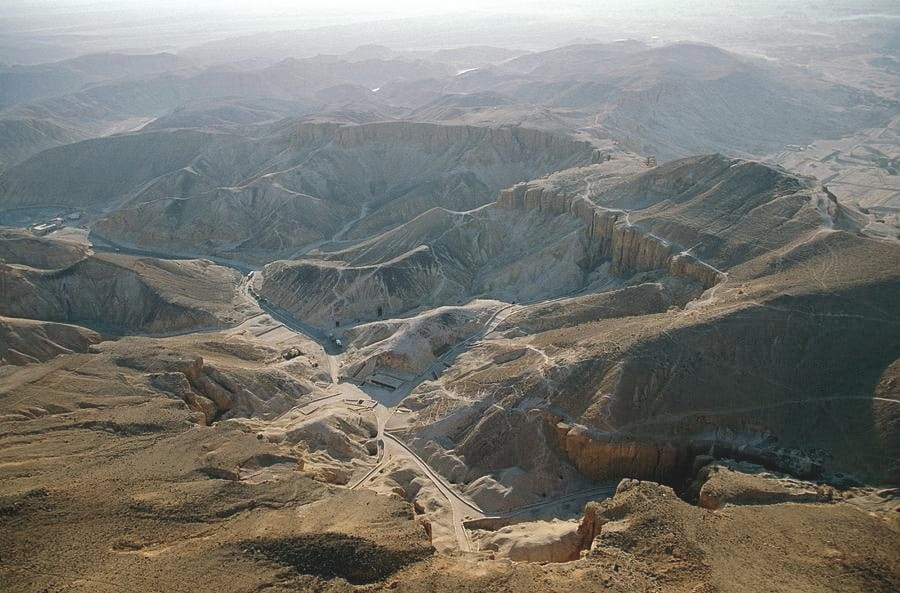
The choice of the Valley of the Kings as Egypt's royal necropolis was not accidental. The valley lies on the west bank of the Nile — the direction of the setting sun, and therefore the realm of the dead in Egyptian cosmology. Above the valley rises al-Qurn — a naturally pyramid-shaped peak that the ancient Egyptians considered sacred, a natural pyramid watching over their kings.

After millennia of pyramid tombs at Memphis (Giza, Saqqara, Dahshur), the pharaohs of the New Kingdom made a radical decision: instead of building monuments visible from a great distance, they would hide. The great pyramids had been systematically looted despite their size. The new approach — cutting invisible tombs deep into limestone cliffs — would, they hoped, defeat the grave robbers. It largely failed. Almost every tomb in the valley was plundered in antiquity, some within decades of sealing. The one exception, preserved by the accident of being buried under debris from a later tomb above, was the small unremarkable tomb of a boy king named Tutankhamun.

The Builders — The Workers of Deir el-Medina

The tombs were built by a permanent community of skilled workers who lived in the nearby village of Deir el-Medina — one of the best-documented communities in the ancient world. Their records, found in the form of ostraca (inscribed pottery fragments) and papyri, reveal details of daily life, wages, labour disputes (including the world's first recorded worker's strike, c. 1170 BC), love poetry, and detailed accounts of the tomb construction process. These workers — painters, plasterers, sculptors, and scribes — were handsomely paid in grain, fish, vegetables, and pottery, reflecting their vital status.

"Can you see anything?" Lord Carnarvon asked from behind. "Yes, wonderful things." — Howard Carter, 26 November 1922, looking through the first breach in Tutankhamun's sealed doorway
Howard Carter excavating
Howard Carter examining one of the golden shrines in Tutankhamun's burial chamber, 1922. Carter spent 10 years methodically removing and cataloguing the 5,398 objects from KV62.
Key Moments in the Valley's History
c.1504 BCThutmose I — first pharaoh buried in the Valley (KV38)
c.1070 BCLast burial — Valley abandoned as royal necropolis
c.1150 BCWorld's first recorded workers' strike — Deir el-Medina workers protest unpaid rations
200 BC–400 ADRoman tourists visit and carve graffiti in the open tombs (KV9 has 1,000+ graffiti)
1799Napoleon's expedition — first systematic survey of the valley
1817Giovanni Belzoni discovers and enters KV17 (Seti I)
1900–1914Theodore Davis excavations — nearly doubles known tombs
1922Howard Carter discovers KV62 — Tutankhamun's intact tomb
1978Theban Mapping Project begins — comprehensive digital documentation
1979UNESCO World Heritage designation
2005KV63 discovered — first new tomb since Tutankhamun
2025Tomb of Thutmose II announced — first royal tomb since KV62 (1922)
𓇳
The Open Tombs — December 2025

Of 65 known tombs, 10 are currently open to visitors. Your standard ticket covers 3 — choose carefully. Four additional tombs require separate premium tickets.

Included in standard ticket (choose 3) Extra ticket required Premium ticket (significant extra cost)
KV2

Ramesses IV

20th Dynasty · c. 1153–1147 BC
⭐⭐⭐⭐⭐
One of the finest tombs to visit — beautifully preserved ceiling paintings, accessible corridors, and extraordinary hieroglyphic inscriptions. The sarcophagus remains in place. Carter's original excavation notes were found inside. Recommended as the first choice for most visitors.
Outstanding ceilingSarcophagus in situAccessible
KV11

Ramesses III

20th Dynasty · c. 1184–1153 BC
⭐⭐⭐⭐⭐
One of the largest tombs in the valley — 125 metres long with vivid colours and lively scenes depicting the pharaoh's military victories, everyday life, and religious texts. Known as the "Harper's Tomb" for its famous painted musicians. Among the best-preserved decorative schemes in the valley.
125m longHarper's TombBattle scenes
KV6

Ramesses IX

20th Dynasty · c. 1129–1111 BC
⭐⭐⭐⭐
Noted for its astronomical ceiling — an extraordinary star chart painted in vivid blue and yellow — and a dramatic judgment scene from the Book of the Dead. One of the most accessible and popular tombs on the standard ticket. Well-preserved despite having been open since antiquity.
Astronomical ceilingBook of the DeadAlways open since antiquity
KV8

Merenptah

19th Dynasty · c. 1213–1203 BC · Son of Ramesses II
⭐⭐⭐⭐
The largest tomb currently open on the standard ticket. Son of the great Ramesses II, Merenptah is famous for the Merenptah Stele — the only contemporary Egyptian text to mention Israel. The tomb is long and has multiple chambers with well-preserved inscriptions.
Largest standard tombMultiple chambersSon of Ramesses II
KV14

Tausert & Setnakht

19th–20th Dynasty · End of New Kingdom
⭐⭐⭐⭐
A fascinating double-use tomb — originally built for Queen Tausert (one of Egypt's female pharaohs) and later expanded and reused by Setnakht. The dual decoration schemes provide a rare insight into how tomb space was repurposed. Excellent painted reliefs throughout.
Female pharaoh tombTwo decorative phasesExcellent reliefs
KV1

Ramesses VII

20th Dynasty · c. 1136–1129 BC · Last pharaoh of dynasty
⭐⭐⭐
A shorter and simpler tomb near the entrance — good for visitors with limited time or energy. One of the last tombs cut in the valley, reflecting the declining wealth of the 20th Dynasty. The sarcophagus remains in the burial chamber.
Near entranceShort visitSarcophagus in place

Also Open on Standard Ticket

KV15 (Sety II) · KV16 (Ramesses I) — smaller but historically significant · KV43 (Thutmose IV) · KV47 (Siptah) — check availability on the day as rotation changes

KV17

Seti I

19th Dynasty · c. 1290–1279 BC
⭐⭐⭐⭐⭐
The finest tomb in the valley — 137 metres long, the deepest and most elaborately decorated of all. Every surface is covered in exquisite painted reliefs of the highest quality. The astronomical ceiling of the burial chamber is one of the greatest works of ancient Egyptian art. Discovered by Belzoni in 1817 — his name is still written in lamp smoke on the ceiling. Worth the 2,000 EGP premium ticket for serious visitors.
Finest in the valley137m longAstronomical ceilingBelzoni 1817
KV62

Tutankhamun

18th Dynasty · c. 1332–1323 BC · The Boy King
⭐⭐⭐⭐⭐
The most famous tomb in the world — and one of the smallest in the valley. Discovered by Howard Carter on 4 November 1922. The mummy of Tutankhamun still lies in its outermost coffin in the burial chamber, in a climate-controlled case. The golden treasures are in GEM (Cairo). The tomb itself is small — the visit is about the historical weight of standing where Carter stood, not about decoration.
Tutankhamun's mummy in situDiscovered 1922Historical pilgrimage
KV9

Ramesses V & VI

20th Dynasty · c. 1147–1137 BC
⭐⭐⭐⭐⭐
One of the most spectacular tombs in the valley — the most complete and best-preserved decorative scheme, including a full astronomical ceiling depicting the goddess Nut swallowing the sun at dusk and giving birth to it at dawn. The tomb also has 1,000+ ancient graffiti from Roman-era tourists. Excellent value at 220 EGP extra.
Complete decorative schemeNut astronomical ceiling1,000+ Roman graffiti
WV23

Ay

18th Dynasty · c. 1323–1319 BC · Successor of Tutankhamun
⭐⭐⭐
The only open tomb in the West Valley — a 25-minute walk from the main site across a remote desert landscape. Ay was Tutankhamun's successor and the tomb's decoration closely resembles KV62. The remote walk and sweeping desert views make it a unique experience for adventurous visitors who have time.
West Valley25-min desert walkSimilar to KV62
⚡ Limited Time — 2 Hours
Essential 3 Tombs
Standard ticket only · EGP 750
Best for: First-time visitors, cruise ship day trips 1. KV2 (Ramesses IV) — finest standard ticket tomb, outstanding ceiling
2. KV11 (Ramesses III) — largest, most vivid colours
3. KV6 (Ramesses IX) — astronomical ceiling

Tip: Go at 6am opening — beat the heat and tour groups
🎯 Half Day — 4 Hours
The Serious Visit
Standard + KV9 extra · EGP 970
Best for: Egypt enthusiasts, second visits Standard: KV2, KV11, KV14 (Tausert)
Extra ticket: KV9 (Ramesses V/VI) — best value in the valley at 220 EGP
Optional: KV62 (Tutankhamun) +700 EGP for the historical experience

Tip: Combine with Deir el-Medina workers' village in the afternoon
🔍 Full Day — 6+ Hours
The Expert Visit
All extras including Seti I · EGP 3,690+
Best for: Egyptologists, passionate archaeology lovers Morning: KV17 (Seti I, 2,000 EGP) — the finest tomb in Egypt
Mid-morning: KV9 + KV62 + standard ticket tombs
Afternoon: Walk to West Valley (WV23, Ay tomb)
Evening: Valley of the Queens + Deir el-Medina

Note: KV17 tickets limited — book the day before at the ticket office
𓏏
Complete Visitor Guide

Everything you need to plan a perfect visit — tickets, how to get there, what to bring, and photography rules updated for December 2025.

🎟️ Ticket Prices — Updated December 2025
TicketPriceIncludes
Standard Entry750 EGPEntry + 3 tombs of your choice from the standard list + tram ride
KV9 — Ramesses V/VI+220 EGPBest value extra — complete decoration + astronomical ceiling
KV62 — Tutankhamun+700 EGPBoy King's mummy in situ · Phone photography only
WV23 — Tomb of Ay+200 EGPWest Valley · 25-min walk · Remote and quiet
KV17 — Seti I+2,000 EGPFinest tomb in Egypt · Limited daily entries · Book early

💳 Payment — Card Only

As of 2025, cash is no longer accepted at the Valley of the Kings ticket office. Payment by credit or debit card only. Two counters: one for standard entry, one for extra-ticket tombs. Decide before joining the queue which extras you want.

📍 Getting There from Luxor
MethodJourneyCost
Private taxi / driver20–30 min from Luxor centreEGP 200–400 (negotiate round trip + wait)
Organised tourPickup from hotel$25–60 USD including guide
Local ferry + taxiFerry across Nile (EGP 10) then taxi on West BankMost affordable option
Bicycle45 min from ferry landingEGP 50–80 bicycle rental · Early morning only
🚐 The Tram
A small electric tram runs from the ticket office to the tomb area — the ride is short but worth it in the heat (included in your ticket). It runs continuously throughout opening hours.
Timing — Critical
Arrive at 6am opening. By 9am the valley is crowded and hot. By 11am it can be 40°C+ in summer. Tour groups arrive between 8–10am. The morning light also creates dramatic shadows on the cliffs. Wednesday/Thursday mornings tend to be quietest.
📱
Photography — 2025 Rules
Mobile phone photography: allowed in all tombs (no separate photography pass required since 2025). No flash anywhere. No professional cameras with interchangeable lenses. Inside KV62 (Tutankhamun): mobile phones only, strictly enforced. No tripods or selfie sticks.
💧
Heat & Hydration
Bring at least 1.5 litres of water per person — there are vendors inside but prices are high. Inside the tombs it is cooler but after exiting the heat shock can be intense. Light cotton clothing, a hat, and sunscreen are essential. The tram provides shade at the visitor centre.
👟
Physical Preparation
Wear comfortable walking shoes — the tombs involve descending steep ramps and stairs (some up to 30m underground). Some tombs have low ceilings requiring ducking. There is no air conditioning inside, but it is naturally cooler underground. The walk to WV23 (Ay's tomb) is 25 minutes across open desert.
🎯
Choose Your 3 Tombs First
Decide before you enter which 3 standard tombs you want — you cannot go back to the ticket area easily. Use the recommendations in the "Our Recommendations" tab above. Once you choose a tomb and enter, it counts as one of your three even if you exit immediately.
🗺️
Get a Map
Maps are available at the ticket office and at the information board at the tram terminus. The tombs are scattered across the valley — without a map you may waste time looking for the ones you want. The Theban Mapping Project also has a detailed digital map at thebanmappingproject.com.
𓁹
Location & Map

The Valley of the Kings lies on the west bank of the Nile directly opposite Luxor — 650 km south of Cairo.

📍 Valley of the Kings · West Bank · Luxor · Upper Egypt · GPS: 25.7402°N, 32.6014°E
𓆓
Combine Your Visit — Nearby Sites

The Valley of the Kings is the centrepiece of the West Bank — but the surrounding area contains some of Egypt's most important sites, all within a few kilometres.

🏛️
Temple of Hatshepsut
📍 2 km · 10 min drive
The magnificent three-terraced mortuary temple of Egypt's greatest female pharaoh — carved directly into the Theban cliffs at Deir el-Bahri. One of the most beautiful buildings in ancient Egypt.
⚰️
Valley of the Queens
📍 2 km · 10 min drive
Over 90 tombs of queens, princes, and nobles. The tomb of Queen Nefertari (QV66) — the finest painted tomb in Egypt — is occasionally open with a premium ticket of 1,500 EGP.
🏘️
Deir el-Medina
📍 1.5 km · 5 min drive
The village of the tomb builders — the best-documented community in the ancient world. Their tombs are small but exquisitely decorated. The workers' records reveal daily life in extraordinary detail.
🏺
Medinet Habu
📍 3 km · 15 min drive
The mortuary temple of Ramesses III — one of the best-preserved temples in Egypt. Dramatic reliefs depicting the Sea Peoples invasion. Often overlooked and usually uncrowded.
🗿
Colossi of Memnon
📍 4 km · 15 min drive
Two 18-metre seated statues of Amenhotep III — all that survives of his vast mortuary temple. Visible from the road and free to view from outside. Famous in Roman times for the "singing" colossus at dawn.
📖
Tombs of the Nobles
📍 3 km · 10 min drive
Over 400 private tombs of nobles and officials — often more vivid and accessible than the royal tombs. Scenes of daily life, banquets, hunting, and agriculture not found in royal tombs. Rarely crowded.
𓂋
Watch & Explore

The best documentaries and tours inside the Valley of the Kings — from aerial drone footage to inside the tombs themselves.

Egypt's Valley of the Kings — Inside King Tut's Tomb & More (2025)

Walk through the Valley of the Kings and descend into Tutankhamun's tomb — full exploration of the open tombs.

Treasures of the Valley of the Kings — Egypt Documentary 4K

Full 4K documentary covering the history, archaeology, and most important tombs of the valley.

Inside Tutankhamun's Tomb — Channel 5 Ancient History Documentary

Bettany Hughes explores Tutankhamun's burial chamber and the incredible story of Howard Carter's 1922 discovery.

𓊹
Test Your Knowledge

8 questions on the Valley of the Kings — from the basic to the expert.

Question 1 of 8
Score: 0
Difficulty: Beginner
Copyright 2024 © EGYPEDIA — All rights reserved